
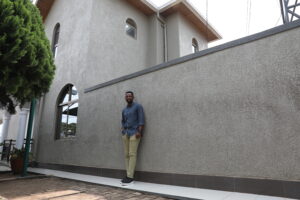
For Rene Gasana, architecture is more than just construction. It is a tool for social justice. He works from the conviction that beautiful, thoughtful design isn’t a luxury for the elite but a basic human right. This belief stems from his upbringing in Rwanda, where Rene witnessed the stark contrast between private comfort and public neglect, which instilled in him a resolve to challenge the notion that some people deserve less. “Every child should attend a good school. Every kid should visit a nicer hospital, even if it doesn’t have to be expensive, but it should be artistically appealing to every human. It’s a human right. The design does not belong to a particular [social] class. When designing a clinic in a rural area… I consider the needs of the people.” That personal commitment to dignity and community-based design was cemented during his very first professional project: the University of Global Health Equity (UGHE) campus in Rwanda, an initiative of Partners In Health.
There, he was inspired by the philosophy of the late Dr. Paul Farmer, whose vision continues to be a source of inspiration. “Starting my very first professional project with Paul Farmer has shaped my understanding of life and my perspective on serving communities, as it involves doing something that communities often lack. And he remains my role model and source of inspiration.” This foundation, driven by a personal commitment to design equity and validated by a leader in global health, drew him to Build Health International. With nearly eight years of design experience, he was fascinated by BHI’s specialized focus on “medical planning,” a discipline he saw as critical to closing the healthcare gap in Rwanda.
Build Health International was the place where he could apply his philosophy with technical expertise, transforming ideas about dignity into high-functioning, quality healthcare infrastructure. Since joining BHI, Rene has channeled this passion into numerous high-impact projects. He has contributed to the conceptual plan for the UGHE campus designed the Plaster House, a specialized children’s orthopedic hospital in Tanzania, and is currently working on the Cameroon Children’s Hospital which is being supported through the African Children’s Healthcare Fund. A core part of BHI’s expertise is navigating the space between a partner’s vision and the principles of medical design. Rene points to his work on the Cameroon Children’s Hospital, where the partner, a doctor, had a strong vision for the layout of surgical and emergency departments. Rather than imposing a different plan, Rene’s team demonstrates BHI’s collaborative method: presenting multiple options with clear pros and cons to find the most effective solution.
“What I realized most of the time is that our partners come to us with their specific goals, and they are the ones who make the decisions. What I like about BHI is that we don’t make the project entirely our own. We help and assist our partners in maximizing their mission and achieving their goals, which ultimately serves the people they’re helping in the long run.”
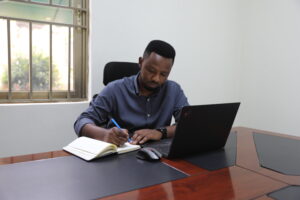
For Rene, the validation from this collaborative process is gratifying. Seeing a partner’s appreciation “gives a purpose to what you’re doing” and creates “inspirational moments.” He is also proud to be part of a team that is so effective and solution-oriented. He admires BHI’s “moving forward” culture, where seasoned architects provide clear direction and every challenge is met with a swift, collaborative solution.
Looking ahead, Rene is most excited to see BHI’s impact deepen across Africa. His dream is to see BHI build world-class healthcare facilities in his home country of Rwanda that can serve as a new standard for the entire region. He considers these projects teaching tools, demonstrating the power of thoughtful medical planning and inspiring a new generation of African architects. For him, this work is driven by the lesson that has shaped his entire career: “Just understand that everyone deserves at least dignity as a human being.”
This story is featured in our 2025 Annual Report. Read it here!
Author: Joseph Doe, Communications Associate, Build Health International