
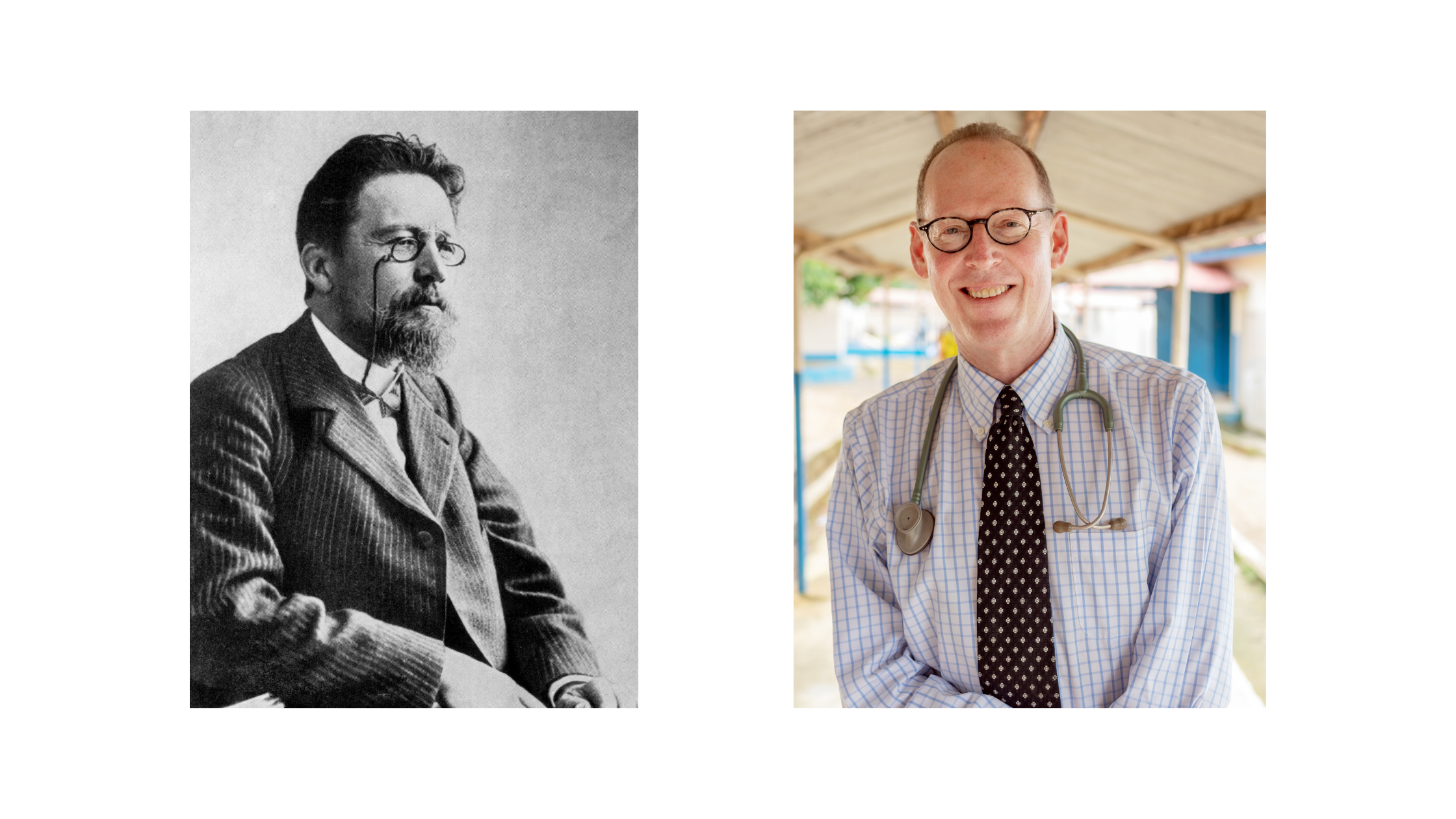
Co-Founder of Partners In Health Dr. Paul Farmer (right) drew inspiration from the author Anton Chekhov (left) in prioritizing health care in the poorest, most remote communities
In his books on global health and social justice, Dr. Paul Farmer cites health justice leaders like Fr. Gustavo Gutiérrez, Rudolph Virchow, Jonathan Mann, and many others as key influences. One of them was the renowned nineteenth century playwright, Anton Chekhov. Farmer loved Russian literature, but he revered the famous author, who was also a physician, for another reason. Chekhov, who would be 166 today, was a nineteenth century predecessor to the modern public health reformer.
More than a hundred years before Farmer co-founded Partners In Health (PIH), Chekhov made a spectacularly difficult trip to Sakhalin Island, one of the most remote penal outposts of the Russian empire, to conduct a census and document the decrepit state of healthcare. Chekhov landed in the town of Aleksandrovsk, which is in the northern, sub-arctic half of the island, where the average winter temperature is 5 °F.
Having lived on Sakhalin myself in the late 1990s, I can attest to the harsh climate that Chekhov found, along with the healthcare challenges in a province that is eight time zones away from Moscow. My wife and I had our first child in Vladivostok (only seven time zones from Moscow), but we opted to have our second one back in the U.S. rather than risk the island’s outdated and under-equipped maternity wards.
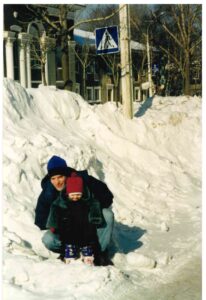
The blog’s author with his daughter on Sakhalin Island in 1998.
Although Farmer did not explicitly refer to Chekhov’s journey in any of his publications, his long-time collaborator, Haun Saussy, recalls discussing Chekhov’s letters from Sakhalin with Farmer. Saussy told me both men were “wonderful observers, very empathetic, able to let go of every pre-established framework when face to face with the problems.” Chekhov’s Sakhalin Island is not simply a social document—it is an early blueprint for an approach to medicine and ethics that Paul Farmer would later name, institutionalize, and operationalize.
In Chekhov’s accounts I find three ways in which his approach may have been a model for Farmer: (1) he modeled the notion of the ethical obligation of being present and the importance of counting underrepresented people, (2) he documented structural violence before the term existed and rejected the idea that some people are less worthy of medical care, and (3) he advocated for basic healthcare infrastructure in remote provinces. Unlike Chekhov, though, Farmer made long term commitments to remote communities and took action.
Being Present
There was no evident professional rationale for Chekhov’s journey to Sakhalin, and it was physically dangerous. He traveled by riverboat, sledge and horse-drawn carriage across the vast, sparsely inhabited taiga of Siberia and the Russian Far East, navigating “abominable roads in freezing temperatures.” The journey “certainly hastened the progress of his tuberculosis and almost certainly deprived him of a few extra years of life.” Yet he felt morally compelled to go, insisting in a letter to his publisher that he expose degradation and suffering in the penal colony, and noting that “we write about life without knowing anything about it, we reason about suffering without having seen suffering…”
Farmer emulated Chekhov when he first started working in Haiti’s remote Central Plateau. He deliberately chose to engage with the “end of the earth,” one of the most impoverished regions in the poorest country of the Western Hemisphere, as Tracy Kidder writes in his 2003 book about Farmer, Mountains Beyond Mountains. Once there, Farmer lived near his patients and interacted with them daily, not only accompanying them through clinical treatment, but trekking to their remote communities to understand their living conditions and the social determinants of their chronically poor health. Both Chekhov and Farmer understood something deeply countercultural: you cannot advocate credibly for people you are unwilling to live among.
This ethic of accompaniment—later formalized by Farmer and Partners In Health—is present in Chekhov’s relentless attention to individual lives amid mass suffering. They both embraced a kind of radical empiricism in service of the poor: counting lives that those in power preferred to keep invisible. Chekhov traveled to Sakhalin not as an author but as a field investigator. He conducted a door-to-door census of roughly 10,000 convicts, exiles, settlers, and indigenous inhabitants, collecting data on mortality, disease prevalence (tuberculosis, syphilis, parasitic infections), housing density, family separation and child labor. This effort among people deemed expendable anticipates Farmer’s work conducting household surveys and epidemiological mapping in rural Haiti. Chekhov and Farmer shared the principle that you cannot claim to care for the poor unless you are willing to count them – and illuminate their plight.
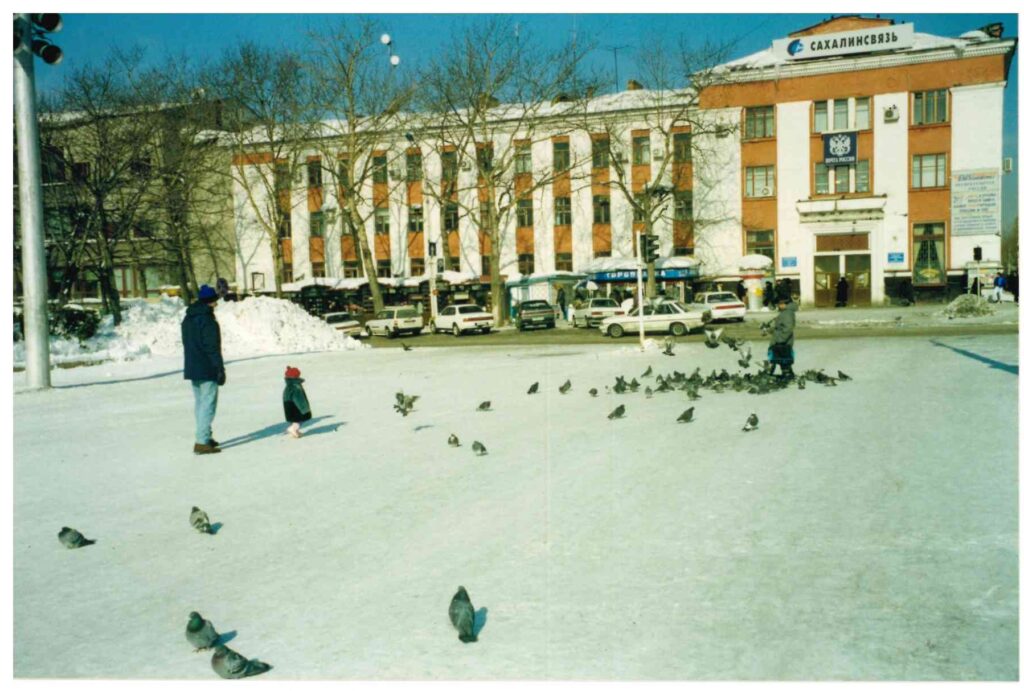
Chekhov traveled to Sakhalin not as an author but as a field investigator to conduct a door-to-door census of inhabitants and document their adverse health conditions. Pictured here is Yuzhno-Sakhalinsk, the capital of Sakhalin Island, in 1998.
All People Are Worthy of Medical Care
Chekhov documented structural violence before the term existed, showing how state neglect can cause illness. He demonstrated that disease on Sakhalin is neither natural nor accidental. He linked failures of provincial administration – like overcrowding, forced labor and legal abandonment – to outbreaks and premature death. This argument presages Farmer’s formulation of structural violence—the idea that social, political, and economic inequalities produce poor health. Both physicians demonstrated that pathology is not merely biological. For Chekhov, prisons and exile fueled tuberculosis. For Farmer, poverty, racism and neoliberal policy powered the spread of AIDS and multidrug-resistant TB.
Both Chekhov and Farmer dismissed the notion that there were parts of the population that were “not worth saving”. Chekhov documents how the Russian state had implicitly decided that convicts, exiles and indigenous peoples were unworthy of investment or care. Farmer spent his career fighting the same logic under different names such as “cost-effective thresholds,” “resource-limited settings,” and “unsustainable interventions.” Both rejected the idea that scarcity excuses abandonment. Chekhov shows us a world where people die because they have been written off. Farmer proves that writing people off is a political choice, not an inevitability.
Championing Healthcare Infrastructure
In Sakhalin Island, Chekhov saves his harshest reviews of the state of health care for his concluding chapter, describing the horrific conditions in which the penal colony’s many tubercular patients lived. He calls the living conditions in these facilities the chief cause of the colony’s “considerable mortality from consumption.” Syphilitics were quartered together with the mentally ill, and he noted that one of the latter had “actually become infected with syphilis.” The medical facilities he described were ‘infirmaries’ or ‘sick bays’; there were no proper hospital facilities anywhere in the region.
Farmer fought for healthcare systems and medical infrastructure the entirety of his career, whether working in or writing about Haiti, Rwanda, Mexico, Peru, Russia, Sierra Leone, or any number of rural locales. In Farmer’s final book, Fevers, Feuds, and Diamonds: Ebola and the Ravages of History, he highlights how epidemic control failed in West Africa because of an absence of infrastructure, including a lack of infection-control, failing facilities, and health systems hollowed out by decades of underinvestment.
Farmer encountered a glaring example of missing infrastructure when the Government of Sierra Leone asked Partners In Health to set up an Ebola treatment unit in Maforki, which later became inundated with Ebola patients. PIH patched their operation together in an abandoned bakery, which had once been part of a vocational school for demobilized post-war combatants. There they treated and saved more than 200 Ebola patients, the kind who were being left for dead at other locations.
Farmer sought answers for why the outbreak got so bad, noting that the colonial British government focused most of its medical efforts on containing – rather than treating – infectious diseases, and much more of its attention on British rather than local patients. “Colonial efforts to provide health services, even those designed to protect public health rather than respond to individual ailments, were…paltry.” In the bleak aftermath of the colonial experiment, “armed conflict left this part of West Africa both a public health desert, which is why Ebola spread, and a clinical desert, which is why Ebola killed.”
Taking Action
Unlike Chekhov, who returned to Moscow after completing his medical census on Sakhalin, Farmer made deep, open-ended commitments to the communities where Partners In Health and their partners work, including Sierra Leone. Following the Ebola outbreak, long-time PIH Board member Al Kaneb remembers challenging Farmer about whether PIH could afford to make a long-term commitment in Sierra Leone. “I was worried that this decision would take away from our efforts in Haiti,” Kaneb said. But Farmer insisted that Partners In Health remain there to help the Government strengthen its health system, hopefully to prevent another catastrophic outbreak, and PIH has been there ever since.
Shortly before his death in 2022, Farmer embraced a plan for what would become a ten-building Maternal Center of Excellence in Kono, Sierra Leone, which suffers among the worst maternal mortality in the world, another vestige of Sierra Leone’s bleak history.

Dr. Paul Farmer’s global health activism ranged from Haiti to Sierra Leone (pictured), where Partners In Health engaged Build Health International to design and construct a ten-building Maternal Center of Excellence, which will open for patients early this year.
I was privileged to help mobilize resources for this project, which Partners In Health entrusted to Build Health International (BHI) to design and construct. From the outset, PIH and BHI channeled Farmer – and Chekhov – in being present by deeply engaging the local community to understand the challenges they face, comprehend what services they need, and involve them in key decisions along the way. BHI took great pride in hiring a mostly women workforce to bring the project to life, training them in trades that will allow them to find other jobs in the region or keep working for the hospital.
After five years of work, the two organizations held a ribbon cutting ceremony this past October, together with Government officials. PIH and BHI expect the facility to open for patients in the next few weeks. With the hope of transforming the landscape of maternal health across the region, the Maternal Center of Excellence should serve as the kind of beacon of health and hope both Chekhov and Farmer fought for.
Andy Wilson is Chief Development Officer at Build Health International. He lived in Russia from 1989-2000, including two years on Sakhalin Island running a logistics company. He worked for Paul Farmer and Partners In Health from 2020-2025.