
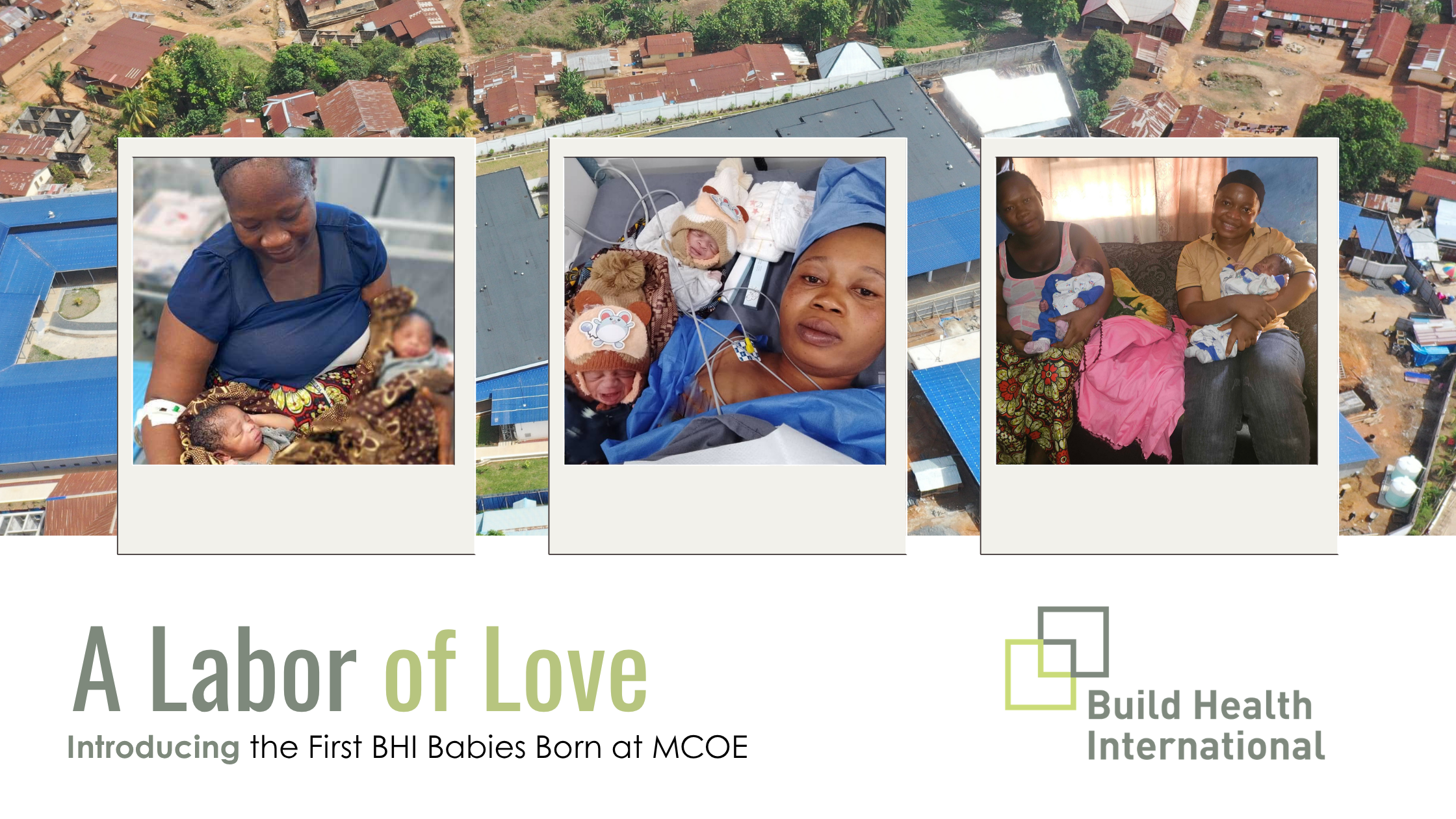
Marion Kargbo and Fanta Sandi contributed to the construction of the Maternal Center of Excellence in Koidu, Sierra Leone, with Build Health International. Months later, both women returned as patients; this time, each gave birth to twins.
Sierra Leone has one of the highest maternal mortality ratios in the world. In Kono District, where quality healthcare remained out of reach, a woman going into labor has historically faced several harsh realities concerning travel and resources.
A new maternal and newborn healthcare facility, the Maternal Center of Excellence, opened its doors to its first patients on February 14, 2026, at the Koidu Government Hospital. This facility was designed and built to permanently change how mothers seek care up to, during, and after pregnancy. Between its opening day and April 30, the facility has already provided life-saving care to 2,957 women and supported the delivery of 901 babies.
Among the many hands that built it were those of Marion Kargbo and Fanta Sandi. As they laid out rooms and cleaned wards through the night before opening day, the idea that they would soon return—not as workers but as mothers—was quickly becoming a reality. Marion and Fanta proudly became the first of the BHI women-led construction workforce to give birth in the very rooms they helped build.
Marion: From Laborer to Patient
Marion Kargbo was selling groundnuts when her sister Kumba Williams told her about a construction project for a new women’s hospital in Kono. Without a background in construction skill trades, she joined the team as a general laborer. Through on-the-job training and hard work, in the years that followed, she rose to become part of the Quality Control team, one of key groups responsible for ensuring the building met the standards it was designed for.
When she became pregnant and learned she was expecting twins, Marion was living in Freetown. She made an important decision about where she would seek care
“I said I will come to Kono. I will give birth in that hospital.”
She had already been hospitalized due to a pregnancy-related condition once before at another facility.
“I was hospitalized with another hospital in Freetown. Between the care there and here [at the MCOE], there is a big difference.”
Marion delivered the twins by Caesarean section. She was alone, without family beside her because they could not make the journey with her. But she was not without support from the dedicated team of trained nursing professionals.
“I gave birth to twins. There was nobody with me. But they [nurses] would help me at night when my babies were crying. They would assist me, take my babies, and comfort them.”
Marion stayed at the facility for three days and was discharged after. The cost of delivery at another facility would have been, in her own words, “a lot of money.”Because at the MCOE, which is managed by Partners In Health, free healthcare services are available to those who seek care. Therefore, she did not have to pay a cent. Beyond Marion’s experience, this fact shapes how other groups will be able to access the same quality care that she was able to receive.
“It means a lot. There are disabled people here, less privileged people. At another hospital, people are dying because they don’t have money. Here, they care and support us.”
Fanta: Delivered at a Facility She Trusts
Fanta Sandi’s journey mirrors this deep connection to the facility. A few months after her second child was born, a friend encouraged her to come and build the MCOE. She joined the team to work on the construction of the facility, and she was there on the final nights before opening, cleaning the wards alongside her colleagues until morning.
When she became pregnant again, like Marion, she returned to seek care.
“I feel extremely happy, considering the fact that it is a hospital that I have built, and I went there again to give birth, and I came out safe. Me and my kids. I am really overjoyed.“
After she gave birth, one of her twins experienced difficulty breathing. The clinical team placed the baby on oxygen and monitored both mother and child through the night. The baby’s blood pressure stabilized, and soon, her breathing returned to normal.
When a nurse began guiding Fanta to her ward, she stopped her and asked which exact building they were heading to:the North Ward? Or the South Ward? The nurse was surprised by the question, but Fanta just smiled.
“I said I worked here. I know all the buildings. I know all the rooms. I know where the Birthing Center is. I know what they do in the south ward and the north ward. I know the building.“
Dignity Built. Not Just Promised
The Maternal Center of Excellence is not just a medical facility; it is a place that treats patients with dignity. Food is served three times a day, there is cold water on demand, sustainable cooling systems that offer respite from the heat, and an accessible and stocked pharmacy.
This state-of-the-art facility was made possible through a partnership between Partners In Health, the Government of Sierra Leone, and Build Health International.
BHI’s approach—building infrastructure while strengthening local capacity—meant that women like Marion and Fanta were not only part of the workforce, but part of a growing system of skill, responsibility, and ownership.
Marion reflects on that journey simply:
“I was there when there was nothing… only grass and a broken building. And I went back and I gave birth there.”
That is the full circle. That is what dignity in healthcare looks like when it is built, not just promised.